All posts by lisatracyauthor

The Anthropology of Food …

Image courtesy of wholeuniverse.com: "The Anthropology of How We Eat"
Image courtesy of wholeuniverse.com: “The Anthropology of How We Eat”

… check out my new food blog at http://wholeuniverse.com/anthropology-eat-sugars-fats-salt/ :

The Anthropology of How We Eat: Sugars, Fats and Salt

by Lisa TracyLook up “food anthropology” on the Web, and you’ll find some fascinating tidbits. One study posits that our gut bacteria are responsible for our cravings. Another says it’s whatever culture we grew up in. A third talks about the uniquely human phenomenon of cooked food. It’s the dopamine, says a fourth site ~ our brains are wired for pleasure, and sugars, fats, and yes, salt trip the nervous-system wires that send the signal to the brain to release the pleasure-linked chemical.

Yes, all good. But WHY?

Why do we eat what we do, and why do we WANT to eat foods we know aren’t healthy?

Let’s start somewhere on this side of the Paleo Diet: Let’s start with potato chips, candy bars, and the Industrial Revolution … read more at http://wholeuniverse.com/anthropology-eat-sugars-fats-salt/

Main Street and MLK

20150119_MLK Main Street[1]

Let me take you for a walk down Main Street.

There are four churches here on Main Street – the first is Manly Memorial Baptist, you see that one on the right, right up front. Manly is a local family name hereabouts and the Manly Mem. website will tell you this church community goes back to 1841 and is supporting work in the Ebola crisis today.

Right across the street from Manly Memorial is Buck’s Barber Shop in that little blue and white house. Main Street is a definite mix of architecture. You can’t see Manly’s dome in this photo, but it is impressive. The dome, I mean.

A ways down the street on the left is the United Methodist Church, where we had Girl Scout meetings in fifth grade and earned our Sewing badge. Across from there is the county administrative building – used to be a department store that when I was a little girl had separate bathrooms for “white” and “colored.” Next to that is the library, and just down the street on the right is Lexington Presbyterian Church, where T.J. “Stonewall” Jackson was an elder, even though he was still quite young, before the Civil War.

But the church whose steeple you can barely see, down near the foot of the Main Street hill, is the one I’m most interested in. It is the only church on Main Street founded by a black congregation, and it’s where we met on the night of Jan. 17 to celebrate Dr. Martin Luther King’s birthday.

And that birthday is the reason I took this picture from the viewpoint I did. I wanted you to see the flags. Maybe you can see that there are American flags and Virginia flags. There are no replicas of Confederate battle flags, and this was the subject of very heated debate a couple of years ago, when the Sons of Confederate Veterans went before City Council to request permission to hang replica flags on the city flag posts for Lee-Jackson Day, a Virginia state holiday that coincidentally falls on the Friday before MLK Day each year. It’s true that Lee-Jackson Day came first, but the Council said no. You can march carrying Confederate flags and wear Confederate grey. You can fly whatever flag you choose on your own property. But not on the city streets.

So the presence of the American and Virginia flags, which occupy every pole from the south end of town to the north and on across Veterans Bridge, are seen as a conscious statement of the city’s choice.

But the debate continues. Virginia Flaggers, as they are now known, picket periodically at the foot of the hill below Lee Chapel, where Robert E. Lee is buried. This year’s Lee-Jackson Day parade began as usual at Jackson’s grave in Stonewall Jackson Cemetery at the south end of town and processed down Main Street to Lexington Presbyterian, where a memorial service was held. Civil War history lectures were advertised by the SCV on banners across Main Street , as were Martin Luther King celebrations, by Washington & Lee University, which had earlier removed Confederate flag replicas from the Lee Chapel, closed the chapel for renovations, and scheduled 10 days of events honoring King.

I went to the opening evening of the MLK celebration, a simple service that is held annually at First Baptist Church, that one at the foot of Main Street. A rock quintet known as the MLK Combo opened the evening with a stunning soul rendition of “This Land is Your Land.” The service consists of the reading, in sections, of King’s “I Have a Dream” speech, interwoven with music by W&L’s three a cappella groups. It is moving beyond words. But the evening begins with the whole congregation/audience on its feet singing “We Shall Overcome.”

As we began to sing, an African-American woman across the aisle from me stepped into the aisle and held out her hand. I stepped into the aisle and took her hand in mine, then reached to my right and took my friend’s hand. Everyone around us and behind us joined hands, and we sang, “Deep in my heart, I do believe …”

And we sat down and listened as Dr. King’s words rolled out like a mighty river.

His dream still holds unfulfilled promise, and until his message is as present in the media and in our minds as are the scandals on college campuses or the gridlock in Congress, his work — and ours — is not done.

Meanwhile, I thank my neighbor for holding out her hand.

Illegal Hunger?

20141207_132523

This report from News.Mic:

Thirty-three cities now ban or are considering banning giving food to homeless people — and some are threatening to throw people in jail in they’re caught feeding the hungry.

These laws claim they’re about preventing government-run anti-homelessness programs from being diluted. They’re really about keeping non-profits and individuals from shining a light on just how bad things have gotten for our country’s poor, even as the homeless are treated like criminals for being without food and shelter.

Charity work like sharing food with the homeless is essential in a country where protecting the poor and needy is never at the top of the list, and is found to help those without shelter get back on their feet.

“Cities think by cutting off the food source, it will make the homeless go away,” NCH community organizing director Michael Stoops said. “It doesn’t.”


ONE SOCK DON’T STOP NO SHOW

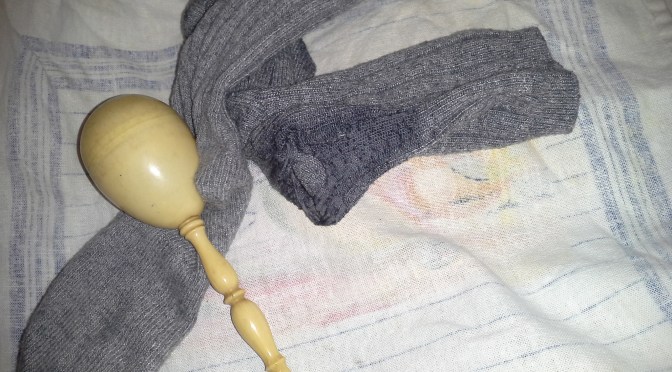
My wool socks
My wool socks


Use it up … Wear it out
Make do … Do without

We grew up with that Yankee frugality.

So this morning when I grabbed a favorite pair of grey wool socks, neatly rolled and folded in the way we pair socks, I was chagrined to discover the holes.

The first sock was fine. But as I pulled on the second one, I saw the small hole at the big toe – and then the huge one at the heel. When and how the heck did that happen?

I loved these socks. They were just the right weight, not too heavy, but wool, so they were really warm. A soft charcoal grey with muted but elegant ribbing, they went with everything.

And now one of them was so ruined that I couldn’t even wear it with clogs or boots.

I was tempted to blame moths, given the wool and the suddenness … but then in truth I reckon these holes were coming on for a while and the last round in the laundry did them in.

Problem now was what to do with them. I know, I know. THROW THEM OUT.

But that’s the problem with material things. They take on a life of their own. They have a personality and a place in your life. You know what I mean: It’s why we like some socks and gloves and jeans and coats better than others. They have their place in the natural order. And these were just impeccable.

I struggled. In another time – a time when I actually HAD time, maybe before the Internet or something – I might have darned them. The picture’s proof that this still wouldn’t be impossible. That’s my grandmother’s darning egg, one of two that came down to my mother, who actually taught us to darn.

So there’s no reason, if I had the time and the inclination, that I couldn’t make this sock almost as good as new. Almost. Truth is, I HAVE darned socks – maybe forty years ago – or more – and they are never quite the same again, no matter what thread or yarn you use. And eventually they come apart again.

Still … back in the day, I darned them with pride. Pride in actually knowing how. Pride of craftsmanship and of beating the house – winning against the odds, salvaging the unsalvageable.

Later, I might have made them into sock puppets. All it takes is a little felt for mouth and ears and buttons for the eyes. Back then I still embroidered, beading little chamois pouches, with blanket stitch around the holes where the drawstring went through. Back then I patched the elbows of sweaters too.

Who knows where the time goes, as Sandy Denny famously remarked? Back then, hours expanded mysteriously into days, and it all got done.

I still have a basket of lone socks I’d imagined might become sock puppets. Before I move again, I guess I’d better throw them out. Or maybe they could be used to polish silver? HA.

Make do … Do without

Wolves, gorillas, sea lions, oh my … Concerts for (other) animals only

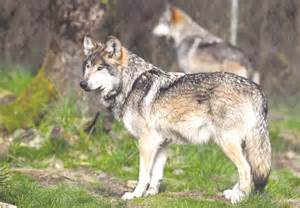
Wolves at Wolf Haven Interational
Wolves at Wolf Haven International


Heard this fascinating item on NPR right before Christmas:  A woman who started out studying depression in (other) animals  reported that those in captivity can be driven mad by boredom.

Laurel Braitman, author of Animal Madness: How Anxious Dogs, Compulsive Parrots, and Elephants in Recovery Help Us Understand Ourselves, began a campaign to try concerts for animals in captivity and in the wild — no humans allowed except the musicians — and observe the results.

The results reported in on WNYC  are fascinating. Listen on   http://www.studio360.org/story/making-music-for-animals! Among the concerts was one by a member of U2 for sea lions; another was hard rock for gorillas.

Wolf Haven, a rescue site in Washington state, was one of the sites described. Wolves who’d been literally chained in captivity now inhabit this wilderness site about 100 miles north of Portland, OR.  Cue the Mozart: Braitman explains how the wolves, free to roam  within the preserve, came right up to the fence where the orchestral group was playing. Marc Bekoff, professor emeritus of ecology and evolutionary biology at the University of Colorado, joined her on the program. Henotes that canids — dogs, wolves, coyotes — can of course hear overtones our human ears will never capture. An intriguing thought.

Kudos to public radio writer/producer Britt Wray for this really riveting Studio 360 program.


Oh Annie, Where Art Thou?

Have you seen the promos for the new ANNIE movie? They are hellzapoppin’ in the best sense, from what I’ve seen … I think I will even go see it, though it is contending with THE IMITATION GAME (on cracking the Enigma code) and a bunch of other top-drawer stuff ~ Oscar contenders all ~ this holiday season. Meanwhile …

Orphan Annie Comic Strip via http://madinkbeard.com/archives/arf-the-life-and-times-of-little-orphan-annie-by-harold-gray
Courtesy of http://madinkbeard.com/archives/arf-the-life-and-times-of-little-orphan-annie-by-harold-gray

The advent of yet another ANNIE incarnation took me back. Waaaaay back. Around 1975, I profiled Shelley Bruce, who replaced Andrea McArdle on Broadway. She was the cover story for our Entertainment section in Shelley’s hometown paper, the Passaic Herald-News, where I was working … But my thoughts of Annie go way farther back, back to Sunday mornings after church, sprawling on the living room floor over the two sections of the Washington Post funnies, divided with my sister. Would you get the section with “Terry and the Pirates” first, or the one with “Little Orphan Annie”? Either way, the message was clear, as it was also with “Steve Canyon” and “The Phantom”: There was evil afoot, and it was totally MYSTERIOUS evil, but the good guys — our guys — would triumph in the end.

For an eight-year-old, this was probably at least as reassuring as whatever we’d learned in Sunday school that day. But now it comes back to haunt me: Who WERE those masked men? Who the heck, more pertinently now, WAS Daddy Warbucks, why were Punjab and the Asp his trusted sidekicks, and why was it so important to protect Little Annie and (Arf!) Sandy?

A search for their creator Harold Gray doesn’t yield much. He himself was orphaned early, and the comics pages of newspapers became his adopted family. He’s said to have started as a populist but grew deeply conservative after the New Deal ~ once a champion of the working poor, ending up deeply hostile to whoever might be undermining America by “taking handouts.”

What caught my fancy, however, was the name Warbucks. “Daddy” in the strip was a self-made man (can you say “war bucks”? This strip rose to its heights between the two World Wars, during the Depression era … ).So what we have here is a guy richer than Croesus OR the Koch brothers … with a heart big enough to take in an orphan and her mangy mutt  … and a guy in a turban, that’s Punjab, and one of the Men in Black, that’s the Asp. And they all have … wait for it … BLANK EYES. Even the dog.  As the Cold War came on, Gray was known to be interested in espionage, but cast of characters and their blank eyes long predate the CIA. They’re from the era when the Great Powers were carving up the Middle East.

So what exactly DO these three guys do when they’re not saving Annie and the world from the forces of evil? Beats me, but it all seems oddly pertinent. Maybe even prescient. And you won’t find it on the big screen this December. For any prophetic metaphor about the world we are living in right now — as depicted in a guy named Warbucks and his two shady sidekicks saving a damsel in distress — for that, well, we’ll just have to read between the lines.

Remembering Dec. 7

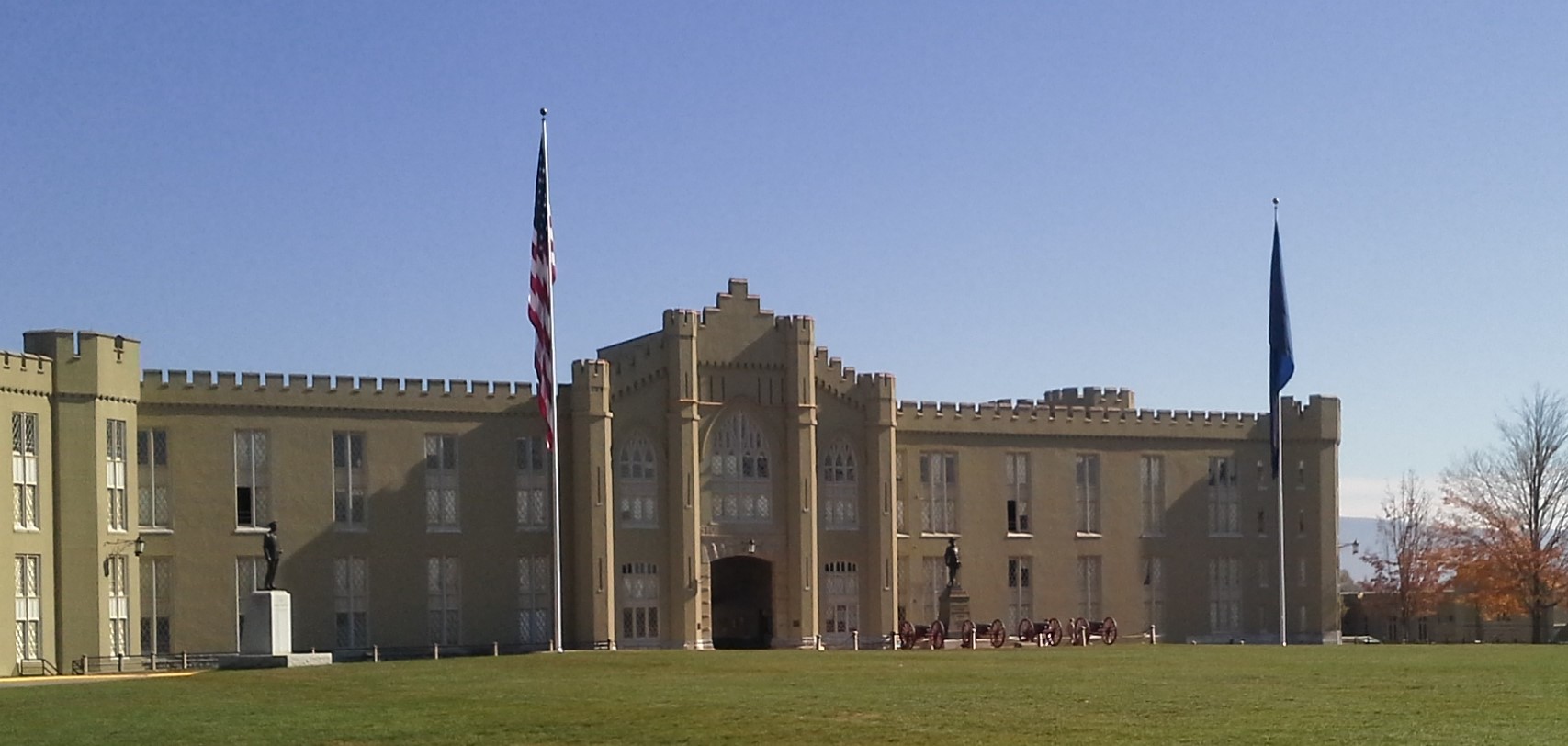
VMI on Nov 11 2014 (2)

I’ve been talking for the past six months with men who were cadets at Virginia Military Institute during World War II and the years surrounding it. Their lives were forever changed on this day, 73 years ago. One of them remembers he was returning to barracks when he heard the news. For him, as for many nationwide, the first question actually was, “Where’s Pearl Harbor”? They, and their country, would soon know all too well.

The day that would live in infamy would call these men, soon to be young officers, to the shores of North Africa, Normandy and the Rhine; to radar stations in England; to bombing missions over Germany and Japan; and even to the prison camps of war. Some knew only the disruption of seemingly endless training, and are chagrined not to have seen the field of battle. Others never returned from it.

On this day, I pause to honor them all. The Institute was indeed heard from, following that day.


Omnivore, herbivore … the conversation continues


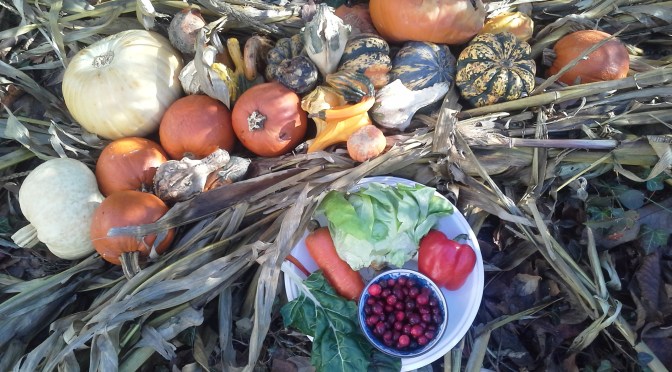
The Locavore Vegetarian, with a red pepper and some cranberries thrown in.

Thanks to Mark at herbfit.wordpress.com and to Mary Lynn at gapsconsulting.com for recent comments about the vegetarian/vegan/omnivore’s dilemma.  Mark points out that most soy currently being raised is fed to animals and that for the sake of the planet we’d do better to eat the animal feed than the animals!

For sure, say I. But I am still focusing on what monoculture crops are doing to the environment, and if you drive in this country through vast areas of Maryland, Virginia and the Carolinas, for example, soy is one of those monocultures. They’re so potentially destructive, with their need for fertilizers and pesticides.

Mary Lynn mentions Weston A. Price’s research. As she says: “His conclusions about the link between food and either chronic degenerative disease or vibrant health came when he studied the diet of those not touched by ‘conventional’ (processed) food. His study, which spanned a decade and took place about 100 years ago, was compelling. He discovered what the healthiest peopl

e ate and he found not a single tribe or community of vegetarians. There was always some sort of animal (or insect) food found in those he studied though he secretly believed he would find healthy people who were vegetarian.”

She notes that our dental structure includes those canine teeth found in carnivores, and adds, “We secrete hydrochloric acid in the stomach which is meant to break down muscle fibers and other proteins.”

But many traditional cultures ate much less animal-based food than we currently do. I know that Mary Lynn doesn’t disagree — she advocates ghee and other animal-based products as well as vegetable fats.

Unfortunately, with a global economy, everyone on the planet now wants to have the opportunity to eat the way only the wealthiest could in the past. How are those of us in the “First World” to deny those who’ve never had the opportunity?

Thanks to both of you for moving this conversation forward. The question for me still remains, How are we going to manage ourselves on this planet in a way that doesn’t destroy the biosphere? As Mark notes, there’s no quick answer here. But let’s keep on working at it.

We remember: 1963

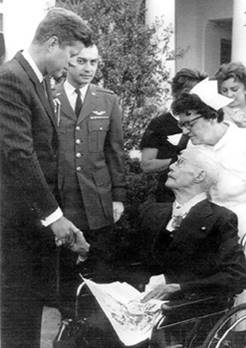
May 1963: Kilbourne and Kennedy at the White House.

Charles Kilbourne meets John Kennedy in May 1963, as oldest living Medal of Honor recipient. Six months later, they died within a week of each other. Both are buried in Arlington National Cemetery.

Rest in peace. Live on in spirit. May we carry on what they began.