Category Archives: Look for America

THOUGHTS TRAVELING ON THE WIND: REFUGEES

 I’m sitting in my cabin in Rockbridge County, Virginia, with a March wind  whistling down from the mountains and a fire in the woodstove.

I’ve been here for about nine months now. Two and a half years after we packed up and sold the family house, got rid of as much stuff as we could and put the rest in storage, as I was unpacking, I found myself actually talking to inanimate objects. After two years of COVID, the loss of beloved family, and multiple temporary dwellings, it was weirdly comforting to be reunited with bits of the past. I guess, once again, that’s what I see in material things … they are just reminders – but reminders they are — of our lives, our loves, our shared humanity.

And then the refrain from the old Tom Petty & the Heartbreakers song started running through my mind: “Don’t – have – to live like a refugee, You don’t have to live like a refugee …”

Yes. And no. No, we don’t have to live like refugees, and yes, that’s the hard truth of it. We don’t, and I think we can’t, know what it is like to leave a lifelong home and not be putting those treasured relics into storage but just to be running for our very lives. Not carrying too much because that could be fatal, if it weighs us down, or causes even a moment more of thought or indecision.

And that refrain has been living with me for the past nine months. After the war in Ukraine started, I put a monthly donation on a credit card for the International Rescue Committee. Just today I inadvertently happened upon a spokesman for the IRC online. He was reminding us that there are 70 million refugees out there on the planet. It’s probably a lot more since he recorded that.

I am haunted by the knowledge that I cannot know what it feels like to know that I will never again see the life I knew — instead, just be grateful for the life I have. Haunted by the knowledge that families are desperately clinging to the tops of train cars to escape untenable lives in Central America; that the Polish and the Belarussians are facing off over migrants on their common border; and then – then, there’s Gaza, and Haiti is in flames. And yes, you can actually be a refugee in your own country or what you thought was your own country.  Words truly fail.

Here in the Valley of Virginia, the town of Lexington has taken in refugee families and helped them acclimate and move on to places where they can find work and a community where people from their country already live. A few miles north of here, the local NAACP chapter has put up a welcoming sign for all people who come our way, whether to stay or just passing through. These efforts can seem small, a drop in the bucket, but I also know we can’t think of them that way. It’s a start. And we forge on.

A local minister speaks regularly about hope, which she defines as “earnest expectation.” This minister happens to be an African American woman who well remembers the era of segregated schools that both she and her mother attended. They both went on to become formidable educators. Her definition is just what you are reading into it: Hope is not about waiting around for a solution; it’s about doing it.

Her hope gives me hope. We start from where we are.

To that, I will just add a prayer for peace, justice, and love of our fellow humans in this world. By prayer I simply mean putting out our best energy in the most focused way we can to raise energy for the good on this planet. The stars are with the voyager, poet Thomas Hood wrote.  May it be so. As the spring equinox signals the ancient start of a new year, may the months ahead bring our Earth’s refugees some peace and safety.

The 11th Hour

Sometimes recently it does seem that way — as if we are living in the 11th hour. Today, as I reflected on that hour of now 100 years ago, I thought of our grandfather, Charlie Kilbourne. He’d have been a vigorous 45 years old that day. He’d been at St. Mihiel and the Meuse-Argonne.  He’d lost the sight of his right eye in a mortar accident, and the shell fragment stayed in his brain till the day he died — too risky to take it out, the Army docs thought, and  he lived almost to age 91. In this photo, he’s somewhere on the Rhine …

I thought as well of Louis Ferdinand Celine’s Voyage au bout de la nuit, his epic World War I era novel, and of his indelible description of the battlefields. As one translation has it, “I cannot refrain from doubting that there exist any genuine realizations of our deepest character except war and illness, those two infinities of nightmare.”

Earlier today I heard the U.S. president, who drew international reproach for failing to show up  on Saturday at the Aisne-Marne American Cemetery and Memorial, murmur something about how good it was that a “brutal” war had ended, way back then. He didn’t sound particularly aware of just how brutal that war was– the intersection of modern and traditional warfare, with deadly weapons and horse-drawn cannon, leaving almost 17 million dead.

It wasn’t surprising. For him, it was probably just one more road trip in a busy schedule. Meanwhile, fires are burning out of control in California, mass shootings in this country are almost a weekly occurrence, the Middle East is in ruins, we’re well into our second decade in Afghanistan, and there’s no such thing as climate change. I’ve just started reading On Desperate Ground, Hampton Sides’s  account of the Korean War. Sometimes it feels as if we too are on desperate ground, though of course not an actual battleground.

But in the face of that, my sister and I recently attended a retreat at an Anglican monastery on the Hudson River. We heard a sermon by one of the youngest of the monks, by the look of him. He spoke of autumn, season of change, reminder of impermanence. He said that, in the times we now inhabit, he has woken lately to look out the window at the brilliant leaves and wonder how many more years he will see them there.

But, he said, this was a sermon about hope — because hope, he said, is an act of insurrection.

As the people of California — fifth largest economy in the world — struggle with natural and unnatural disasters and as refugees from Central America are met with U.S. troops, we also see a shift in the political climate, more young people and women stepping up to lead, more voices speaking out.

Let us hope. And let that act of insurrection lead us onward.

As the French would say, Soit-il.  Let it be so. 

Time like a river

Hola, kith, kin and world … last time I was here, we were in the middle of a #MeToo moment … and we still are. In case you missed it, This American Life just ran a stunning interview with LaDonna Powell, the woman who blew the whistle loudest on a firm called Allied Universal Security. Check it out at https://www.thisamericanlife.org/647/ladonna or https://www.thisamericanlife.org/647/transcript.  Her story broke first in NYC last fall — and it is a pretty uglyone. As NPR picked it up this spring, a harassment lawsuit had just been filed..

The story makes you want never to fly again … since Allied staffs most of the airport security you might encounter — like from New York City, where the story broke, to LA, and everything in between. But wait, Allied also serves (or in a particularly icky terminology of their own, “services”) college campuses, chemical facilities, and just about anything else you can think of.

So in case we think this #MeToo issue is anywhere near getting resolved … well, at least one big company has been hauled into court for looking the other way while its employees were — to quote the headlines — “forced to watch sex romps” and “harassed and forced to quit.”

At the end of the interview, Ms. Powell was asked if it made her feel empowered that her harassers had been called to account. Not surprisingly, she said no.

Indeed: Her job is gone, her peace of mind with it, a whole life she had built for herself. And worst of all, perhaps, she is just one of many. Because a big (huge?) company like Allied knows that it can always find someone else to do the job. And they do. Routinely. And it all blows over.

You know what I call it? Persecution.  Persecution of the people of our culture, our nation, our world who have the least to gain and the most to lose. Minorities,whether of race, gender, nationality, ethnicity, economics, you name it. Anyone without the luxury of the material resources or the time — or the political or social clout — to fight injustice when it happens to them or someone they care about.

Persecution. Institutionalized persecution. And it applies not only to women who have been and are being routinely sexually harassed at the workplace, though some of those women are the ones who’ve put #MeToo on the map.

It applies to everyone from the children being separated from their parents at the U.S.-Mexico border, even when their parents actually have a legal right to be there — everyone from those children right on up to the NFL players who “took the knee.”

You think I’m veering off into the deep weeds here? Think about it. My ancestors and a bunch of yours too, probably, came to this country fleeing religious or political persecution, virtual economic slavery, or a host of other injustices.

And persecution is what it’s about here today, at the hands of powerful institutions including some of our own “American” governments, from the federal level on down.

And by the way, in conclusion, anyone who thinks kneeling is a sign of rebellion or disrespect needs to read Elizabeth Bruenig’s “The NFL fumbles on kneeling” in the Washington Post:

Kneeling during the anthem was always a kind of plea — for an America that works the way the civics textbooks say it does. But making the plea raises the fact that America doesn’t, in fact, function according to its founding story … Some are protected more than others, and some better than others, and some at the expense of others, and it isn’t clear that our representative bodies are interested in doing anything about it. All Colin Kaepernick and others ever did was ask.

You can find it at http://thewashingtonpost.newspaperdirect.com/epaper/viewer.aspx.

So time, like a river, has rushed past me since last fall, as family and friends dealt with some health issues — we’re better now, thanks, all OK — and so … and so you get a twofer.

Onward … and, as I always say (T.S. Eliot, “Dry Salvages”), Not farewell, but fare forward.


#metoo — We’ve come a long way (baby)?

Perhaps we actually are making progress. Hugh Hefner is dead – not that I wish him any ill, but his passing did engender some reflection – and Harvey Weinstein is en route to some self-prescribed loony bin.

They may be the emblems, but the progress – if there is some – is in the form of the thousands of #metoo ‘s and the reports that sparked them, women and men all over the world coming forward with their stories, some of them long muted.

When I heard the #metoo’s included stories of groping, at first I was bemused (Sister, weren’t we all?), being a woman of a generation where you were routinely humped from behind by some nameless stranger on a subway so packed you couldn’t even turn around to face him.

He wasn’t your main concern. Your main concern was whether you could arrive at work with your hair more or less in place and without any big sweat stains under your arms from riding the Sardines Express on the Lexington Avenue IRT. Because in the world of men where you were lucky to have any kind of job, keeping that job depended mostly on keeping up your appearance and knowing how to keep your mouth shut.

In the world of New York corporate broadcasting, you didn’t get groped most of the time. Sexism, though, was definitely there, suffusing the very air we breathed, determining who got to drink out of a china cup in the board room and who took coffee in Styrofoam from the cafeteria. If you should chance to find yourself in an important meeting, you were in the midst of a verbal game of “keep away.” You might come in with a list of story ideas, and the men would jump right in. But as a woman, just try to make eye contact with the man who’s running the meeting. And if you did get a word in edgewise, it would likely be ignored, and then ten minutes later a man would present YOUR idea, get credit and a big pat on the back.

Like abuse, though subtler and at least physically less painful and dangerous, exclusion was an instrument of control. And both have been in effect, pretty much, as long as we’ve been running the world as a patriarchy.

There, I’ve said it, the P word, and some of the ears in the room have shut down. That’s not what we want, so let’s start over. Everyone keep your voice down. Speak slowly and distinctly. Avoid injecting attitude. Try to sound thoughtful and deliberate. Make eye contact.

Oh, and the gavel? Symbol of order in the court and of whose turn it is to speak, the talking stick.

So here goes. We meet today to discuss some major issues. They include:

  • Racism.
  • The possibility of nuclear war and how we’ll deal with its aftermath.
  • The threat of fascism, here and globally.

Those are my top three. Women’s rights and sexual equality aren’t even on the list, but they are embedded in it. What are yours?

Charlottesville. And beyond.

We’re an hour southwest of Charlottesville, and I was horrified but sadly not wholly surprised as events unfolded there in Emancipation — formerly Lee – Park yesterday.

A friend who has worked for the State Department in some pretty dicey locations abroad — a man still in his early 30s — sent this message: “Let there be no confusion: this was deliberate terrorism. My prayers with victims. Stay home.”

This is not just about Charlottesville, nor even mainly so. This is about all of us and our divided nation. I’m not telling you anything you don’t know.

In the 24 hours since, two more messages, if you will — one of hope, one of warning — and a prayer.

The warning, from “The World of Evan Osnos” (New Yorker), in an essay on the Chinese dissident Xu Hongci: “What is the precise moment, in the life of a country, when tyranny takes hold? It rarely happens in the instant; it arrives like twilight, and at first, our eyes adjust.” (Like the proverbial frog dropped first into lukewarm water on the stove?)

To that, I would say, find and read “The Dark Valley,” a scholarly study of how fascism arose and World War II followed in the 1930s. We’re seeing something all too similar.

On a more hopeful note, yesterday NPR was talking with Volusia County, Fla., sheriff Mike Chitwood, who is requiring de-escalation training for his deputies following a rash of shootings. He’d built a  successful police department in Daytona Beach, he said, in part by requiring all   prospective officers to take a course in the history of racism — because, he said, “We are a racist country, have been from the start.” He had a good deal more to say — identifying the racism implicit in the theft of native American homelands and destruction of their culture as well as slavery, Jim Crow and all that has followed it.

Chitwood also served in the Philadelphia, Pa., police department. He spoke about getting retrained, as an officer, how not to be trigger happy. About how just a split second can tell you that a man is pulling out his wallet and not a gun. About how police involvement in communities doesn’t stop with visits to schools, but requires constant feet on the street.

Can’t find the newscast — and his reputation as “top cop” in Daytona may not hold up — but as events were unfolding in Charlottesville — and as that city’s police failed to de-escalate a situation that many  had foreseen —  it did offer a sliver of hope.

At least someone, somewhere, in a position of some authority is thinking: Thinking about how incidents like what happened yesterday do not arise out of thin air. Thinking about the long, thick and tangled legacy of racism in this country, and what we can and must do to dismantle it.

Last, this from NYC, from a friend who’s been a parishioner at  St. Clement’s, located in what used to be called Hell’s Kitchen,  for many years:

O God, you have bound us together in a common life. Help us, in the midst of our struggles for justice and truth, to confront one another without hatred or bitterness, and to work together in mutual forbearance and respect …

Amen.

Tribalism: It’s not always pretty

Back in freshman history, Ms. Marcia Colish flung the story of Western civilization at us at warp speed.

She talked about how empires rise and fall. First, there would be tribalism, though she didn’t call it that.

No, she didn’t call it that because back then, we mistakenly thought that tribes only existed in “uncivilized” parts of the world, which didn’t even merit mention. Her course started with the fall of the Roman empire, but didn’t dwell on its causes. Instead we waved at the Patristic (dig that etymology) scholars and then sailed on to the Merovingians and Carolingians.

So the story back then began with warring dukes and wannabe kings and emperors. Back then, as Rome fell and Byzantium faded eastward, there was of course the “Holy Roman Empire.”

But what there really was, was tribalism. We just didn’t call it that. Still, Ms. Colish gave us the fundamental principle: Empires fall. They crumble into chaos and then – she taught us – nation-building starts. Nations arise and then they grow into empires, and then those empires fall and so it goes, on and on.

What we didn’t appreciate, because we didn’t see we were in the middle of it, is just how messy the fall of empires can be.

And we never studied what really happens when an empire crumbles. It doesn’t go right back into nations; now we see, it goes down to the bones. And the bones, because evolution is slow, are tribes.

So here we are now, in a global economy with 24/7/365 ¼ communications, working at the tribal level to get the world’s work accomplished every day and try to prevent incinerating ourselves in the meantime.

How’s that working for you?

Two good essays on Salon.com this morning tackle the subject as it’s manifesting itself right here in America. Never mind the lethal and tragic tribalism of street culture vs. the police; this morning’s essays look at why Trump voters can’t even admit to themselves that they might have  been wrong – because tribalism is such a deeply embedded survival mechanism:   http://www.salon.com/2017/06/21/watch-why-trump-fans-wont-dump-him-now/

And in an interestingly congruent essay, Lucian Truscott IV – he of the Jefferson family scandal and many trenchant  insights into our society – writes about “power without money” – about how you motivate scared human beings to go out and fight a war when there’s no  immediate reward in it for them and they are too many to punish … and how that is exactly what our nation’s underpaid, unloved but faithful government bureaucracy is, and how Trump hates those bureaucrats because he doesn’t understand the concept of power without money.

Or maybe, I am thinking, he understands it very well on an instinctive level. Instinctively, he knows these faceless functionaries are not of his tribe, and he is exerting all of his own power to dismantle and destroy them.

Just thinkin’ … read Truscott at http://www.salon.com/2017/06/21/power-in-the-absence-of-money/ …and hope that our justice system and those patient, faceless bureaucrats survive this bout of tribalism. But as Ms. Colish never quite pointed out, when empires crumble, nations are not what they crumble into. They crumble into tribes, and it is messy and dangerous. Like the Dark Ages.

Let us pray ..

The Coal Camp Series

If you  are anywhere within a 100-mile radius of Roanoke, Virginia — or even if you aren’t — you need to make a beeline for the Hollins University campus, just off I-81. There at the Eleanor D. Wilson Museum, you’ll find the very best of Lenny Lyons Bruno’s work. But you need to hurry — this is the last week.

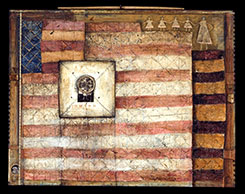
Lenny was born to a coal-mining family. Her Coal Camp Series tells it like it was — and like it really, essentially, still is.  Her artworks are often made using old quilts as her canvases. Her sculptures employ found objects to viscerally evoke the life she and her siblings knew — going to school barefoot and threadbare, getting ridiculed because with all the transiency of the coal camps, they’d never learned to read, didn’t know the protocol of a classroom, and were shabby and grimy from the constant of their lives: coal dust,  King Coal, a shack if you were lucky, and the company store.

“Blackberry Winter” is the painting you see at the far end of the gallery as you walk in. It’s Lenny’s tribute to her mother — pregnant again, on the move, no food in the house except the blackberries they’d picked in the summer and put up.

The art is intriguing and evocative in and of itself. But it also speaks to just one of America’s big failings — and of the courage and grit one family found to get through it.

If you check out the website https://www.hollins.edu/museum/index.shtml, that first picture in the slide show is one of Lenny’s, and it is probably my favorite: “Fold Inward,” it speaks of the pattern of their survival; of hope and tragedy and transcendence. The background, as it happens, is a variation on the American flag.

Lenny’s work deserves a permanent place in a museum of its own. If you can’t get to Roanoke, this ferociously long URL may do the trick. Just mend the breaks and you’re in business. Or just Google Lenny Lyons Bruno. I promise you won’t be disappointed:

https://www.google.com/search?q=lenny+lyons+bruno&tbm=isch&tbo=u&source=univ&sa=X&ved=0ahUKEwjO_5Ck7p_SAhXIOyYKHSyBAgYQsAQITw&biw=1150&bih=635

John Lewis is my hero


And he has been for a long time. Today’s New Yorker article by David Remnick testifies to some of the reasons why.

The link above should take you to Remnick’s essay. Meanwhile:

John Lewis came to the military college in my small hometown here almost two years ago to accept a civil rights award. Many of us townsfolk went to Virginia Military Institute’s big sports arena to witness the event, so proud that even in this Southern mountain town, we have come a ways.

Not far enough yet, as Lewis himself has made clear. But on Saturday, about 700 people marched peacefully through our town in memory of Martin Luther King’s message to the nation, and in an expression of  community and inclusiveness. It was that, and more. The next evening — last night — several hundred of us were privileged to hear Diane Nash give the MLK Day address at our other college, Washington & Lee University.

There’s irony here — Robert E. Lee is buried on the W&L campus — but we want to get past that. Ms. Nash — who as a college sophomore decades ago was a chief organizer of the Freedom Rides — spoke about her life,  about Dr. King and her association with him, and about how the civil rights movement in her view was created and carried out by people who refused to accept oppression. She spoke of “agapic energy,” the energy that enables you to get past hating your opponent and to target the institutions and beliefs that keep oppression in place.

This was just one day after both  the CARE Initiative march honoring King and the by now customary showing of Confederate flags were captured by the New York Times in a video — https://www.nytimes.com/2017/01/16/us/parades-lexington-virginia-martin-luther-king-jr-robert-e-lee.html. That didn’t faze Ms. Nash, who is entirely equal to facing down a flag and much more.  But for us who remain behind, it was a reminder that we’re not in that “place just right”  — not just yet.

And so, John Lewis. Once again this man who has walked so many miles for freedom and justice — who has walked with the wind and against it and has never faltered — once again this man, in the fullness of his years, is talking with his feet. He is not attending the inauguration of a man who has mocked the disabled, women, and people of all races other than his own.

Here’s an excerpt from Remnick, quoting Lewis:

Testifying at Sessions’s confirmation hearing, Lewis said, “Those who are committed to equal justice in our society wonder whether Senator Sessions’s call for law and order will mean today what it meant in Alabama when I was coming up back then.”

“We’ve made progress, but we are not there yet,” he continued. “There are forces that want to take us back to another place. We don’t want to go back. We want to go forward. As the late A. Philip Randolph, who was the dean of the March on Washington, in 1963, often said, ‘Maybe our forefathers and our foremothers all came to this great land in different ships, but we’re all in the same boat now.’ It doesn’t matter how Senator Sessions may smile, how friendly he may be, how he may speak to you, but we need someone who’s going to stand up and speak up and speak out for the people that need help, for people who are being discriminated against.”

So we still have work to do.  And Ms. Nash has the recipe, which she shared last night with students, professors and townspeople: Investigate. Make your plan. Hit the streets. Keep at it.   And love your enemy, because the energy of love is the most powerful and the only reliable force we have going for us. Agapic energy. Onward.


And about West Virginia …

OK, I promise this is the last time you’ll hear from me about the severe disconnect in this country, at least until after Nov. 8.

I voted for President Obama twice and I’d do it again in a heartbeat. I hope he goes down in history as the smart, courageous, compassionate human being he is, and for all he has accomplished.

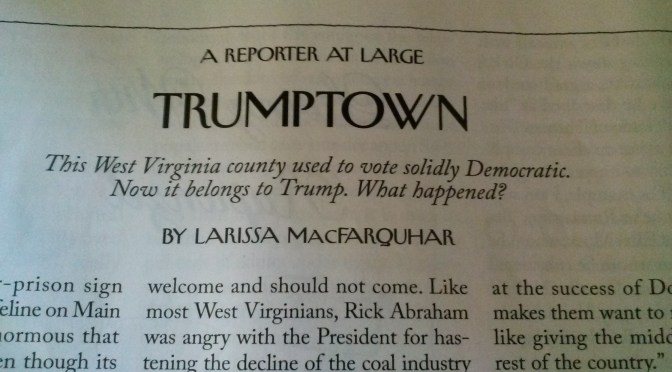
It turns out, in the latest New Yorker, that a big chunk of West Virginia voted for him too. That was a surprise, to me at least.

But this time they’re voting for Trump. And “Trump Country” explains why. An excerpt:

Trump seemed … to treat West Virginia like family, and he had noticed that many West Virginians in return treated Trump like family, brushing off the things he said that sounded nuts or that they didn’t agree with. “In Iraq, I listened to David Petraeus speak every day about how we had to rebuild Iraq’s oil infrastructure and protect it,” Richard Ojeda says. “But, if we’re going to go to trillions of dollars in debt over Iraq, why can’t we go billions of dollars in debt and make every single coal-producing plant clean in West Virginia? Don’t we deserve a hand? We built this country with the steel that came out of our coal, and we protected this country with our soldiers, and nobody cares. We’re more willing to give millions of dollars to people in other countries who’d just as soon put a bullet in the back of our heads. That’s why West Virginia is going to vote for Trump.”

The thing is, it really doesn’t matter whether we agree with, like, or admire each other at this point. If we don’t resolve our differences in some way, we’re pretty much doomed. Of course that includes differences with people we may have been taught to disregard, disrespect, even despise. My sister says the core Trump constituency is made up of people who know they’ve pretty much been written off, personally and economically. I think she’s right.

I’m seeking to start with understanding, hoping for discourse.

The link: http://www.newyorker.com/magazine/2016/10/10/in-the-heart-of-trump-country

9/11/2016

Fifteen years … so much has happened that we couldn’t have foretold, in these fifteen years. But today I am not thinking about all we might wish to have changed, or what we now know about ourselves and the world that we didn’t know that we knew, on that day.

Today I heard from a friend who was working for FEMA that day. And I’m thinking of another who was living in New York.

Susan, then working for FEMA, sends this:

I was supposed to fly to Europe that evening .  Instead, FEMA deployed me …  I was assigned to Arlington to do what we could for Virginians affected by the attack on the Pentagon.  My daily morning task was listening to the general brief families. Day after day we were told about non-viewable remains recovered from the rubble of the Pentagon.  I accompanied the families on the last site visit before it was closed. As difficult as being in Washington was, I was grateful not to be called to New York, which held so many more personal connections.  I still struggle with retirement and have been going through  years of files.

My young friend Emily was living in the Apple, bartending at an East Side sports bar.  New York was her dream. She lived on Liberty Street, right under the towers. She called them her mountains – they were central to her love of New York and her life in the city, a landmark that could take her safely home to her little shared apartment in  southern Manhattan no matter what the time of day or night.

That morning, she woke to thunder in the sky and an earthquake below. Her building was vibrating. She threw on her new Nikes and ran to the roof. There she saw it all – the flames, the wavering buildings, the people leaping from their windows. She was maybe 22. “We have to run, they’re going to fall,” she told her roommate. They fled their tiny building and ran – ran in their pajamas amid falling debris and burning shreds of paper – across Manhattan to the Brooklyn Bridge. Across the Brooklyn Bridge to safety at a friend’s apartment.

They all survived that day, those young people, and they are living and working and thriving as I write this. But I know that a part of their core being, in their minds and their hearts, remains forever rooted in that day.

And so it is for those of us who stood farther from the hideous signal of a world we did not completely, perhaps at all, understand. We are still struggling to get to sanity. Let it be.

https://www.youtube.com/watch?v=W5vGho1fEw4